

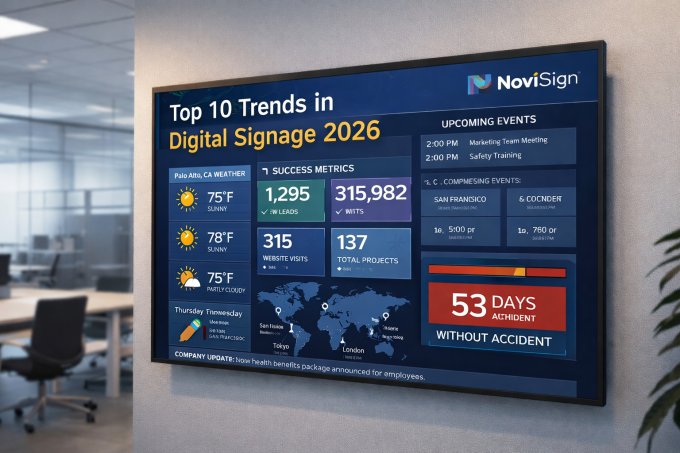
As we enter 2026, digital signage is no longer a niche technology. It has become part of the physical infrastructure of cities, businesses, transportation hubs, retail, hospitality, and corporate environments.
The question is no longer if digital signage will be used — but how deeply it will be embedded into everyday operations, communications, and revenue models.
Here are the ten forces shaping digital signage in 2026.
1. More screens — and LED everywhere
The number of digital screens continues to grow across almost every environment. We see displays appearing in more locations, in more formats, and at larger scales.
At the same time, LED is moving far beyond outdoor billboards. Large-format LED displays are now becoming common indoors as well — in corporate lobbies, retail spaces, transportation hubs, control rooms, event venues, and public buildings. Falling prices, improved reliability, and flexible installation options are making LED one of the fastest-growing display technologies in digital signage.
2. Android as the dominant player platform
Android has become the standard operating system for digital signage players and system-on-chip displays. What started more than a decade ago as an emerging option is now the backbone of the industry.
Its global hardware ecosystem, affordability, and flexibility make it the default choice for both small deployments and large-scale networks.
3. Cloud as the default operating model
Cloud-based digital signage software is now the norm. Centralized management, remote updates, real-time scheduling, and scalable deployments all rely on cloud platforms.
On-premise systems still exist in highly regulated sectors such as defense and banking, but for most of the market, cloud is now the standard operating model.
4. Cybersecurity becomes non-negotiable
As digital signage becomes more connected and more visible, security becomes critical. Screens are no longer just displays — they are networked systems that can influence public messaging and brand trust.
Two-factor authentication, role-based access control, encrypted communication, and secure platform design are now basic requirements for any professional digital signage solution.
5. Digital signage inside organizations
Digital signage is no longer limited to retail and advertising. Screens are becoming a core internal communication layer inside offices, factories, hospitals, campuses, and corporate environments.
Organizations use them for HR updates, performance dashboards, company messaging, safety, branding, and daily communication with employees.
6. Deep system integrations
Digital signage platforms are no longer standalone systems. They are being connected to HR, ERP, CRM, BI, IoT, and operational platforms.
This turns screens into real-time business displays that show live data, alerts, performance metrics, and operational status — not just static content.
7. AI built into the platform
Artificial intelligence has moved from hype to reality. In 2026, AI is embedded in digital signage platforms for content creation, image and text generation, scheduling, automation, and data-driven optimization.
AI reduces the cost and complexity of managing large networks while improving relevance and personalization.
8. Do-it-yourself deployments
System-on-chip displays and cloud platforms have made digital signage easier to deploy than ever.
Organizations now expect to set up, manage, and update their signage networks without heavy IT involvement or specialized integrators. Ease of use, fast onboarding, and low maintenance are becoming major decision factors.
9. Digital advertising and DOOH keep growing
Digital Out-of-Home (DOOH) advertising continues to expand rapidly. More venues are monetizing their screens — either by selling advertising directly or by connecting their displays to ad networks and programmatic platforms.
Digital signage is increasingly becoming a revenue-generating asset, not just a communication tool.
10. Digital signage becomes a platform
Perhaps the most important shift is that digital signage is no longer just software for displaying content — it is becoming a platform.
Just as the web and mobile became foundations for building products and services, digital signage is now becoming a platform where organizations, developers, and partners build applications, integrations, workflows, and new experiences. Screens are evolving from endpoints into programmable digital environments.
Looking ahead
Together, these ten forces show where the industry is going.
Digital signage in 2026 is not just about displaying content. It is about running software, connecting systems, generating revenue, enabling automation, and delivering real-time experiences in physical spaces.
The screen is becoming one of the most powerful digital touchpoints in the real world — and in 2026, its role is only getting bigger.